

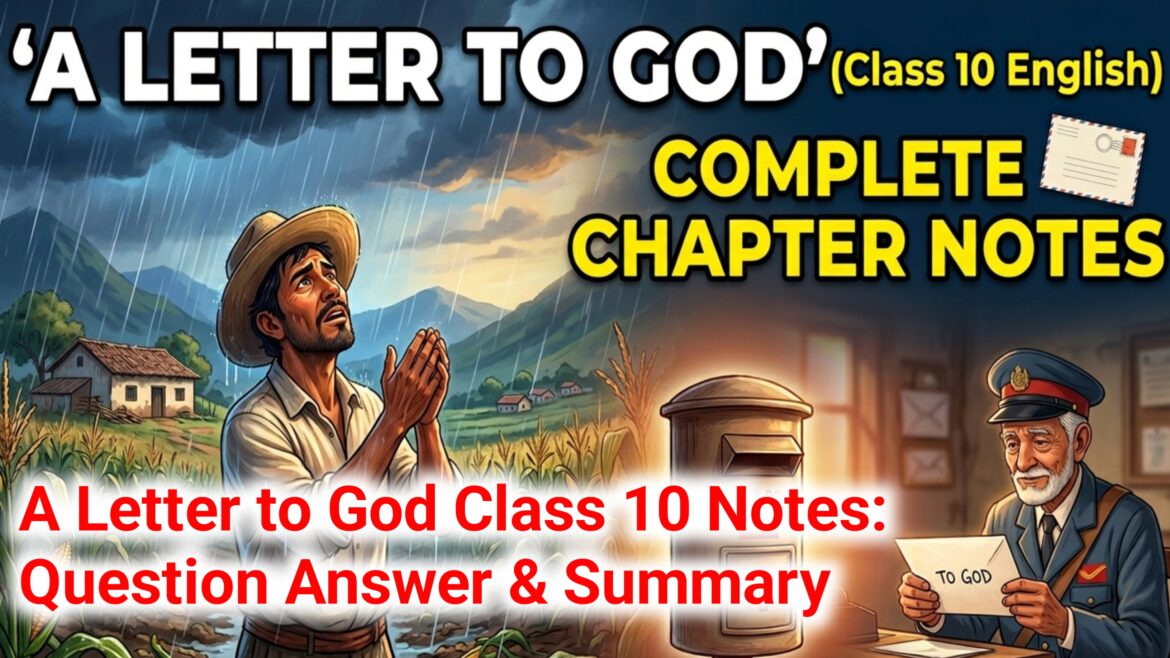
A Letter to God Class 10 Notes: Question Answer & Summary
A Letter to God Class 10 Notes: Question Answer & Summary
About the Author
G.L. Fuentes was a famous Mexican writer and journalist. He was born on July 17, 1897. He grew up among farmers, which helped him write stories that are simple and realistic. He is known for showing the deep faith and struggles of ordinary people. He died on December 10, 1966.
Summary of “A Letter to God”
1. Lencho’s Hope – Lencho was a hardworking farmer. He was waiting for rain so his corn crops would grow well. When it finally started raining, he was very happy.
2. The Storm – Suddenly, the rain turned into a heavy hailstorm. Large ice balls fell from the sky and destroyed his entire crop. Lencho was very sad because he had no food left for his family.
3. Faith in God – Lencho had a very strong belief in God. He believed that God helps everyone. So, he wrote a letter to God asking for 100 pesos (money) to plant his crops again.
4. The Postmaster’s Help – When the postmaster saw the letter, he was surprised. He didn’t want to break Lencho’s faith. He collected money from his staff and friends. He could only collect 70 pesos. He put the money in an envelope and signed it as “God.”
5. The Irony – The next Sunday, Lencho went to the post office. When he found only 70 pesos, he got angry. He thought God couldn’t make a mistake, so the post office workers must have stolen his money.
6. The Ending – Lencho wrote another letter to God. He asked for the rest of the money but told God not to send it by mail because he thought the post office employees were a “bunch of crooks”
Important Word-Meanings & Glossary
| No. | Word | English Meaning | Hindi Meaning |
|---|---|---|---|
| 1 | Crest | The top of a hill | पहाड़ी की चोटी |
| 2 | Harvest | The crop that is gathered | फसल |
| 3 | Downpour | Heavy rain | मूसलाधार बारिश |
| 4 | Drape | To cover | ढकना / लपेटना |
| 5 | Predict | To tell the future | भविष्यवाणी करना |
| 6 | Exclaim | To cry out suddenly | चिल्लाकर कहना |
| 7 | Resemble | To look like | के समान दिखना |
| 8 | Expose | To leave unprotected | खुला छोड़ देना |
| 9 | Frozen pearls | Hailstones (metaphor) | ओले (जमे हुए मोती) |
| 10 | Plague | A large destructive group | महामारी / आफत |
| 11 | Locusts | Insects that destroy crops | टिड्डियाँ |
| 12 | Solitary | Alone / Single | अकेला / एकांत |
| 13 | Conscience | Inner sense of right/wrong | अंतरात्मा |
| 14 | Ox of a man | Very hardworking/strong | बहुत मेहनती व्यक्ति |
| 15 | Sow | To plant seeds | बीज बोना |
| 16 | Amiable | Friendly and pleasant | मिलनसार |
| 17 | Correspondence | Communication by letters | पत्र-व्यवहार |
| 18 | Goodwill | Friendly or helpful feeling | नेक नीयती / सद्भावना |
| 19 | Resolution | A firm decision | दृढ़ निश्चय |
| 20 | Obliged | Forced or required | मजबूर / आभारी |
| 21 | Charity | Giving help/money | दान / पुण्य |
| 22 | Contentment | Satisfaction | संतोष / संतुष्टि |
| 23 | Slightest | Smallest amount | ज़रा सा भी |
| 24 | Confidence | Firm trust | आत्मविश्वास / भरोसा |
| 25 | Denied | Refused | मना कर दिया |
| 26 | Wrinkling | Small lines on skin/brow | झुर्रियां पड़ना |
| 27 | Effort | Hard work | प्रयास / कोशिश |
| 28 | Licked | To pass tongue over | चाटना |
| 29 | Affixed | Stuck or attached | चिपकाया |
| 30 | Blow | A hard hit | प्रहार (यहाँ मुक्के से) |
| 31 | Crooks | Dishonest people / Thieves | बेईमान लोग / ठग |
| 32 | Valley | Low land between hills | घाटी |
| 33 | Corn | Maize | मक्का |
| 34 | Supper | Evening meal | रात का भोजन |
| 35 | Intimate | Very close / Familiar | परिचित / नज़दीकी |
| 36 | Hailstone | Small balls of ice | ओले |
| 37 | Utterly | Completely | पूरी तरह से |
| 38 | Sorrowful | Very sad | दुखद |
| 39 | Rest | Remaining part | शेष / बचा हुआ |
| 40 | Bunch | A group of something | समूह / झुंड |
Character Sketch of Lencho
1. A Hardworking Farmer : Lencho was a very dedicated and industrious farmer. The author describes him as an “ox of a man,” which means he worked extremely hard in his fields, just like an animal, to provide for his family.
2. Strong Faith in God :The most striking trait of Lencho was his unwavering faith in God. Even when a hailstorm destroyed every single bit of his crop, he did not lose hope. He believed that God sees everything and would never let anyone die of hunger. This deep faith led him to write a letter directly to God.
3. Simple and Innocent : Lencho was a very simple and innocent person. He was not aware of how the world or the postal system truly worked. He actually believed that God would read his letter and send him money in an envelope. His innocence is shown when he doesn’t find it strange to receive a reply from “God.”
4. Lacked Trust in Humans : While he had immense faith in God, he lacked trust in fellow human beings. Even though the post office employees who helped him by donating money, he blindly suspected them of stealing. He quickly called them a “bunch of crooks” without considering that they might have helped him.
Oral Comprehension Check
1. What did Lencho hope for?
Ans: Lencho hoped for a good rain or a downpour. He needed the water for his ripe corn fields to get a healthy harvest.
2. Why did Lencho say the raindrops were like ‘new coins’?
Ans: Lencho compared the raindrops to coins because a good rain meant a good harvest. More corn meant more money for his family. He called the big drops ‘ten-cent pieces’ and the little ones ‘fives’.
3. How did the rain change? What happened to Lencho’s fields?
Ans: Suddenly, a strong wind began to blow, and the rain changed into a heavy hailstorm. Large hailstones fell for an hour. As a result, Lencho’s fields were completely destroyed, and the corn was totally wiped out.
4. What were Lencho’s feelings when the hail stopped?
Ans: Lencho was filled with deep sadness. Looking at his ruined field, he felt that they would have no corn that year and that his family might go hungry. He felt hopeless and heartbroken.
5. Who or what did Lencho have faith in? What did he do?
Ans: Lencho had deep faith in God. He believed that God sees everything and helps everyone. Because of this faith, he wrote a letter to God asking for 100 pesos to help his family and replant his crops.
6. Who read the letter?
Ans: The postmaster read the letter. (A postman first found it and showed it to the postmaster).
7. What did the postmaster do then?
Ans: The postmaster did not want to break Lencho’s faith. He collected money from his employees and friends, and gave a part of his own salary. He sent an envelope with 70 pesos to Lencho and signed it as “God.”
8. Was Lencho surprised to find a letter for him with money in it?
Ans: No, Lencho was not surprised at all. He had such deep and total faith in God that he was completely sure God would answer his request and send the money.
9. What made him angry?
Ans: Lencho became angry when he counted the money. He had asked for 100 pesos, but he found only 70 pesos in the envelope. He believed that God could not make a mistake, so he thought the post office employees had stolen his 30 pesos.
Thinking about the Text
1. Who does Lencho have complete faith in? Which sentences in the story tell you this?
Ans: Lencho has complete faith in God.The sentences that show this are :
• “Lencho showed not the slightest surprise on seeing the money; such was his confidence.”
• “But in the hearts of all who lived in that solitary house… there was a single hope: help from God.”
• “God,” he wrote, “if you don’t help me, my family and I will go hungry this year.”
2. Why does the postmaster send money to Lencho? Why does he sign the letter ‘God’?
Ans: The postmaster is a kind man. He sends the money because he is moved by Lencho’s faith and doesn’t want to shake it. He signs the letter ‘God’ so Lencho believes that God himself has answered his request and sent the help.
3. Did Lencho try to find out who had sent the money to him? Why/Why not?
Ans: No, Lencho did not try to find out who sent the money. This is because he had total confidence that God would help him. To him, the money coming from God was a natural thing, not a mystery to solve.
4. Who does Lencho think has taken the rest of the money? What is the irony in the situation?
Ans: Lencho thinks the post office employees have stolen the remaining 30 pesos.
The Irony: The irony is that the post office workers are the ones who actually collected their own money to help Lencho. Instead of being grateful to them, Lencho calls them a “bunch of crooks” and blames them for stealing.
Question 5: Are there people like Lencho in the real world? What kind of a person would you say he is? (Use: greedy, naive, stupid, ungrateful, selfish, comical, unquestioning).
Answer: Yes, it is possible to find people like Lencho in the real world, though they are very rare. For example, my friend Ravi is somewhat like him. We can describe such a person using the following words from the box:
Naive and Unquestioning : Like Lencho, Ravi is very naive (innocent). He has an unquestioning nature, meaning he believes in things easily without asking for proof.
Stupid and Comical : Sometimes, Ravi’s extreme innocence makes him look a bit stupid in practical situations. His habit of talking to statues or writing letters to imaginary characters can be comical (funny) for others.
Ungrateful : Because people like Lencho or Ravi are so focused on their own beliefs, they can sometimes appear ungrateful. They may not realize when someone is helping them behind the scenes.
Greedy and Selfish : In the story, Lencho was not really greedy or selfish; he only asked for what he needed to survive. However, because he demanded more money and called the staff “crooks,” some might wrongly think he was being selfish.
Conclusion : In short, people like Ravi and Lencho are “pure at heart” but they lack “worldly wisdom”. Their innocence is their strength, but it also makes them misunderstand the people around them.
Q6. There are two kinds of conflict in the story: between humans and nature, and between humans themselves. How are these illustrated?
Ans: The story “A Letter to God” shows two types of struggles (conflicts):
1. Conflict between Humans and Nature:
This is shown through Lencho’s hard work being destroyed by the weather.
The Situation: Lencho worked like an “ox” and waited for rain to help his crops.
The Conflict: Nature, in the form of a violent hailstorm, destroyed everything. It shows that despite human hard work, nature can be powerful and sometimes very cruel, leaving a man with nothing.
2. Conflict between Humans themselves:This is shown through the lack of trust between Lencho and the post office employees.
The Situation: The postmaster and his staff were kind and generous. They gave their own money to help a stranger (Lencho).
The Conflict: Instead of being grateful, Lencho suspected them. He believed that the humans at the post office had stolen his money and called them a “bunch of crooks.” This shows how humans often fail to understand each other’s goodness.
Thinking about Language
I. Names of Storms
There are different names for storms depending on their nature and where they happen. Here are the correct matches:
- A violent tropical storm in which strong winds move in a circle: CYCLONE
- An extremely strong wind: GALE
- A violent tropical storm with very strong winds: TYPHOON
- A violent storm whose centre is a cloud in the shape of a funnel: TORNADO
- A violent storm with very strong winds, especially in the western Atlantic Ocean: HURRICANE
- A very strong wind that moves very fast in a spinning movement and causes a lot of damage: WHIRLWIND
II. The Use of ‘Hope’ as a Noun and a Verb
The Question : Notice how the word ‘hope’ is used in these sentences from the story:(a) I hope it (the hailstorm) passes quickly. (Used as a Verb — an action of wishing).(b) There was a single hope: help from God. (Used as a Noun — a thing or a feeling).
I. Match the sentences in Column A with the meanings of ‘hope’ in Column B.
| A | B |
| 1. Will you get the subjects you want to study? I hope so. | Wanting something to happen (and thinking it is quite possible). |
| 2. I hope you don’t mind my saying this, but I don’t like the way you are arguing. | Showing concern that what you say should not offend or disturb; a way of being polite. |
| 3. This discovery will give new hope to HIV/AIDS sufferers. | A feeling that something good will probably happen. |
| 4. We were hoping against hope that the judges would not notice our mistakes. | Wishing for something to happen, although this is very unlikely. |
| 5. I called early in the hope of speaking to her before she went to school. | Thinking that this would happen (It may or may not have happened). |
| 6. Just when everybody had given up hope, the fishermen came back. | Stopped believing that this good thing would happen. |
III. Relative Clauses
This exercise teaches you how to join two sentences using who (for people) and which (for places/things).
1. I often go to Mumbai. Mumbai is the commercial capital of India. (which)
Ans: I often go to Mumbai, which is the commercial capital of India.
2. My mother is going to host a TV show on cooking. She cooks very well. (who)
Ans: My mother, who cooks very well, is going to host a TV show on cooking.
3. These sportsmen are going to meet the President. Their performance has been excellent. (whose)
Ans: These sportsmen, whose performance has been excellent, are going to meet the President.
4. Lencho prayed to God. His eyes see into our minds. (whose)
Ans: Lencho prayed to God, whose eyes see into our minds.
5. This man cheated me. I trusted him. (whom)
Ans: This man, whom I trusted, cheated me.
Using Negatives for Emphasis
Find sentences in the story with negative words, which express the following ideas emphatically.
1. The trees lost all their leaves.
Ans: Not a leaf remained on the trees.
2. The letter was addressed to God himself.
Ans: It was nothing less than a letter to God.
3. The postman saw this address for the first time in his career.
Ans: Never in his career as a postman had he known that address.
III. Metaphors from the Story
| Object | Metaphor | Quality Compared |
|---|---|---|
| Cloud | Huge mountains of clouds | The mass or ‘hugeness’ of mountains. |
| Raindrops | New coins | Size, shape, and monetary value. |
| Hailstones | Frozen pearls | Round, hard, and shining like pearls. |
| Locusts | A plague of locusts | Something that spreads fast and destroys. |
| Lencho | An ox of a man | Hardworking and strong as an ox. |
Listening Task
Note: This table is usually filled based on a letter read aloud in class. Below are the typical answers for this exercise.
| The writer apologises (says sorry) because | He/she has not written for a long time. |
| The writer has sent this to the reader | To share news and maintain their friendship. |
| The writer sent it in the month of | (Depends on the audio—often October/November). |
| The reason for not writing earlier | The writer was busy with exams or moving home. |
| Sarah goes to | Her new school/college in another city. |
| Who is writing to whom? | A friend is writing to another friend |
| Where and when were they last together? | At their old school during the summer holidays. |